
New self-assessment tool: where does your organisation stand – and what should you focus on next?
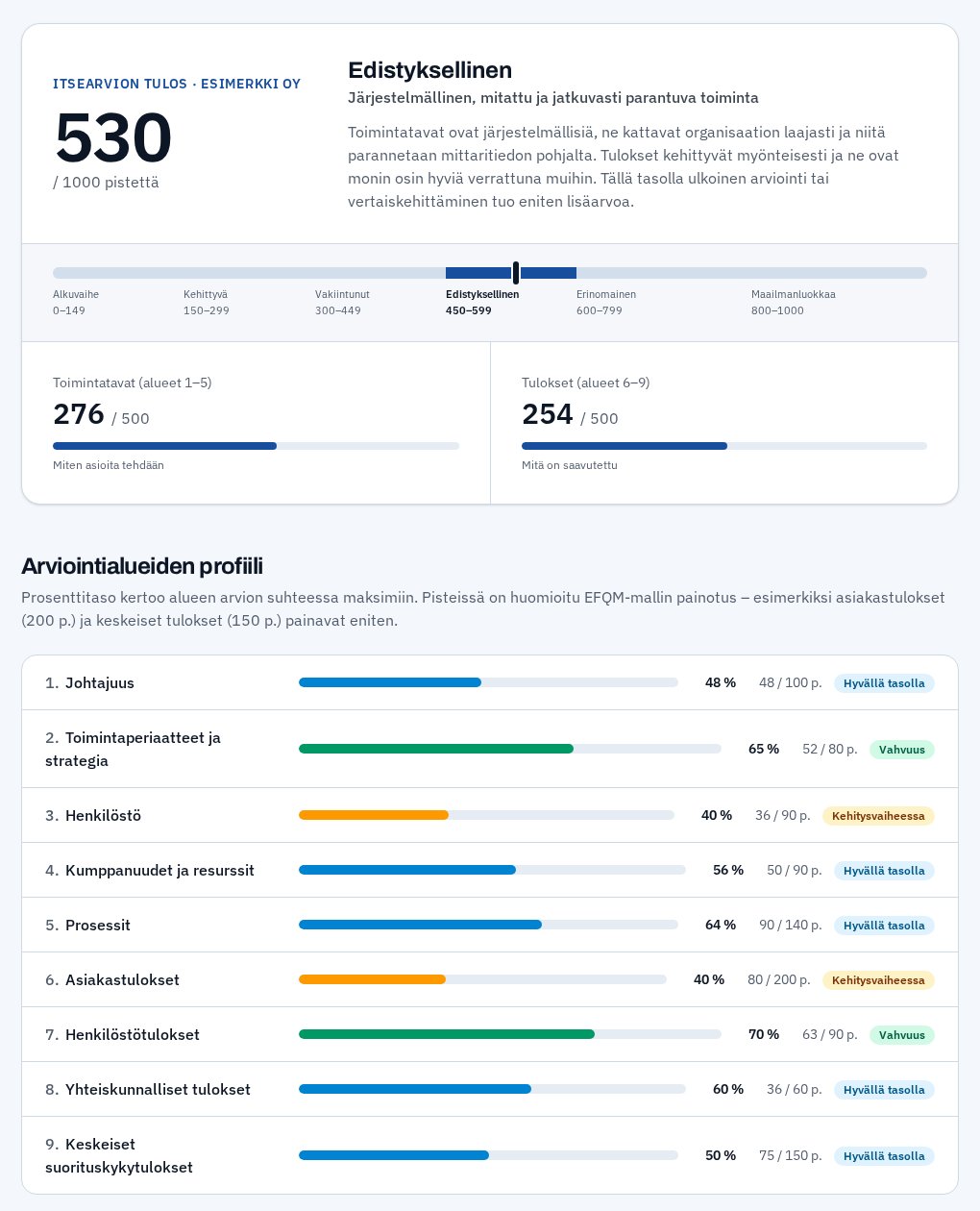
Many leadership teams know intuitively where their organisation is strong and where it falls short. Rarely, however, is that picture structured so that development priorities can be derived directly from it. That is why I have published a new, free self-assessment tool on this site (in Finnish).
What is the assessment based on?
The tool is based on the EFQM Excellence Model as it was in use around 2008–2010. The model has since been revised, but its nine assessment areas remain a clear and practical way to structure an organisation's approaches and results. You assess your organisation in nine areas: leadership, policy and strategy, people, partnerships and resources, processes, and customer, people, society and key performance results. The areas are weighted according to the model – customer results and key results carry the most weight.
Each statement is rated on a 0–5 scale, from serious shortcoming to world class. The assessment takes about 20 minutes, and you can continue an unfinished assessment later.
What does the result look like?
The results page brings everything together in one view:
- Total score (0–1000) and maturity level – from early stage to world class, with a written description.
- Approaches vs. results – does good practice show up in results, or the other way round?
- Area profile – each area as a percentage and points, labelled as a strength, good level or developing.
- Where you excel and where to improve most – concrete development tips for the weakest items.
How does it help?
The value of the assessment comes from the discussion. When leadership team members complete it individually, differences in their views often say as much as the scores themselves. The profile helps you pick a few development areas with the greatest impact instead of improving everything at once. Repeated over time, it also works as a metric: is development showing in results?
Results can be printed, and if you wish, I will go through them with you and help turn them into actions.